
Why ask your grandparents
Most families mean to ask and never quite do. The stories are told in pieces at birthdays and in the car, and nobody writes them down. A list of questions turns “one day” into an afternoon where you sit down together, ask, and keep what they say. Grandparents are often glad to be asked.
There is some evidence that it matters for children too. In 2010 Emory University psychologists Marshall Duke and Robyn Fivush, with Jennifer Bohanek, reported a study of 66 teenagers aged 14 to 16. They had made a “Do You Know” scale of 20 yes or no questions, such as how the teenager’s parents met and where relatives grew up. Teenagers who knew more of these family stories showed higher emotional well-being and higher “identity achievement”, a more settled sense of who they are. The authors said more research was needed, so treat it as a hint rather than proof.
The answers are for you as much as for the children. Grandma’s first kitchen and how Grandpa got his first job are small stories, and nobody else can tell them.
What makes a good question
A good question to ask your grandparents is small and concrete. It points at one place, one person or one moment, so the answer comes as a scene with details in it. “What did you eat at lunchtime at school?” leads to the dinner lady, the queue and the pudding they hated. “What was school like?” usually gets “Oh, much stricter than now”.
- Ask about things, places and people. The house, the street, the first car, the teacher, the best friend. Memory hangs on objects.
- Ask open questions. The Smithsonian’s interviewing guide for grandparents and grandchildren suggests avoiding questions that can be answered with yes or no, and following up by asking for an example or when it happened.
- Start easy. The same guide suggests opening with a familiar story or basic facts about their life to break the ice. The tool puts childhood first and advice last for that reason.
- Ask one thing at a time. A short follow-up is fine, but a question with three parts gets an answer to one of them.
- Leave room for follow-ups. The best question is often the second one: “What happened next?”, “Who else was there?”, “What did it smell like?”, “What did your mother say?”
Adapt the wording to the person. StoryCorps, which has recorded conversations between relatives for years, offers its own question lists by theme and invites people to use the ones they like and write their own. That is how the list above works as well: swap any question that doesn’t fit, and add your own with the box under the list.
How to ask: in person, by phone or by letter
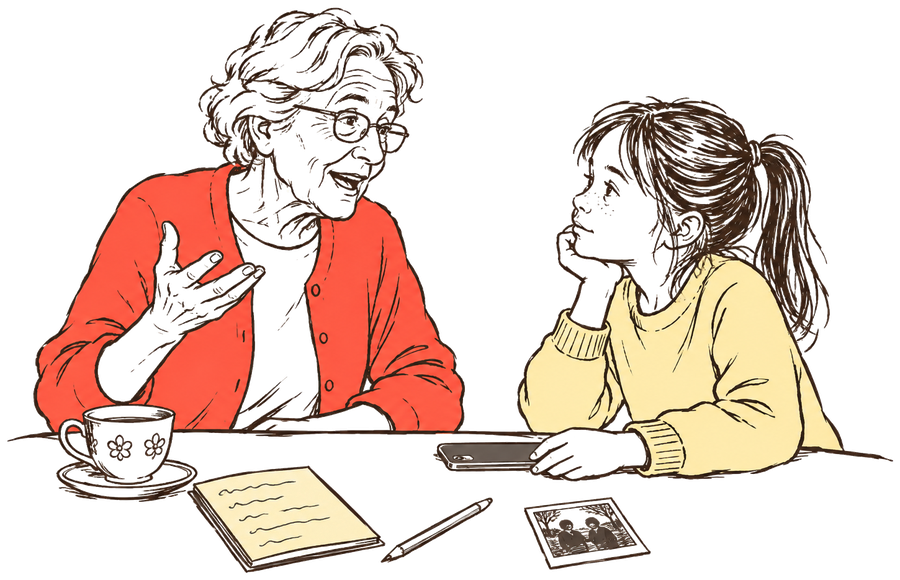
In person is best when you can. Sit side by side rather than across a desk, with a cup of tea and something to look at. The Smithsonian guide suggests bringing props such as old photographs, letters and keepsakes to help memories come back. A photo album open between you does half the asking.
By phone or video call works well for grandparents who live far away. Send the list a few days before so they have time to think, and agree on two or three questions per call. Calls are shorter and more tiring than visits, so a weekly call with one question can go further than one long interview.
By letter or email suits grandparents who like to write, or who find it easier to think on paper. Print the list with room under each question and post it with a stamped envelope for the reply, or send one question at a time by email. Written answers are shorter, but they arrive in their own handwriting or words, which is worth keeping too.
When a child is asking
Children can be very good interviewers. Grandparents often answer a grandchild with more patience and detail than they would give an adult, and children ask the follow-up questions adults are too polite to ask.
Choose “A child of 5 to 10” in the tool and the questions become short and concrete: “Did you have a pet? What was its name?”, “What did you get in trouble for when you were little?”, “What was I like when I was a baby?” Questions that need a grown-up’s tact, such as hard times or money, are left out of that list.
- Let the child pick four or five questions from the printed sheet and read them out.
- Sit in, and ask a follow-up when the child doesn’t: “Tell us more about that dog.”
- Give the child a job: holding the phone that records, or ticking off each question.
- Stop while it is still fun. Fifteen minutes is a good first visit for a five-year-old.
A parent can also ask on a child’s behalf. Choose “A parent” and the questions about the grandchild change to name your child: what Grandma remembers about the day they were born, who in the family they remind her of, what she would like them to know about her when they are older. Answers like these mean most to a child who is too young to ask them yet.
Hard memories and quiet grandparents
Some questions touch on loss: a war, a parent who died young, a move they did not choose, years when money was short. Leave those for later in the conversation, or for another day, once they are at ease. If they wave a question away, move on without comment. You can come back to it another time, or not at all.
Some grandparents say they have nothing interesting to tell. That usually changes with concrete questions about ordinary things: what they had for breakfast, the walk to school, the first wage packet. If talk dries up, look at a photo together and ask who took it. The Smithsonian guide also suggests watching for tiredness and planning another session when the person begins to tire. Several short visits beat one long one.
How to record the answers
Record their voice if they agree. Notes keep the facts, but a recording keeps the way they tell it: the pauses, the laugh, the words only they use. A phone is enough. On an iPhone use Voice Memos; on Android phones, use the recorder app that comes with the phone, such as Recorder on Google Pixel, which can also write down the words.
- Ask first. Tell them what the recording is for and who will hear it. The Smithsonian guide says never to record someone without their knowledge.
- Test it. Record ten seconds and play it back. Put the phone on the table between you, screen down, away from the teacups and the radio.
- Say who and when. Start with “It’s Sunday 15 November, and I’m talking to Grandma at her kitchen table.” The Smithsonian guide suggests this kind of introduction, so the file explains itself in years to come.
- Leave it running. Stopping and starting breaks the flow, and the best story often comes after you thought you had finished.
- Back it up the same day. Name the file with their name, the date and the theme, and keep a copy somewhere other than the phone.
Our guide on how to save voice messages covers getting recordings off an iPhone or Android phone and keeping them safe.
A sample visit
Here is how the tool and a visit fit together, step by step.
An eight-year-old asks Grandma about childhood
- In the tool: Grandma, “A child of 5 to 10”, the theme Childhood, and 5 questions. The child swaps one question they don’t like and adds their own: “What was your street called?”
- Print the sheet. With five questions it leaves three lines under each for notes.
- At Grandma’s, the parent sets Voice Memos running and says the date and who is there. The child reads the first question: “What games did you play outside?”
- Grandma talks about playing in the street until it got dark. The parent asks two follow-ups: “Who did you play with?” and “What happened when it got dark?”
- After four questions and about twenty minutes, they stop. The fifth question stays for next time.
- That evening the parent saves the recording as “Grandma, childhood, 15 Nov 2026” and backs it up.
Next visit, pick another theme. There are eleven, so a visit a month takes you through every theme in under a year, and by then you have hours of Grandma telling her life in her own voice.
All 153 questions, by theme
Every question in the tool, in the wording for a grandchild asking. In the tool, a child’s list uses simpler wording for 125 of them, and a parent’s list turns the questions about the grandchild towards their child.
Childhood
The house, the street, the games and the people of their first years.
- What is the first thing you can remember? How old were you?
- Describe the house you grew up in. Which room do you see first when you think of it?
- Who lived in your home when you were small, and who else was always around?
- What did you get told off for most?
- What games did you play outside, and how far were you allowed to go on your own?
- Which toy do you still remember, and what happened to it?
- What did your bedroom look like, and did you share it?
- What was a Saturday like when you were ten?
- Did you have a pet, or want one badly?
- What scared you as a child, and who made it better?
- What was the best present you got as a child?
- Who was your best friend growing up, and what did you get up to together?
- What jobs did you have to do around the house?
- What smell takes you straight back to being small?
- Who looked after you when you were ill as a child?
School
Teachers, lunches, friends and what came after.
- What was your first school like, and how did you get there each day?
- Which teacher do you still remember, and why?
- What was your best subject, and your worst?
- What did you eat at lunchtime?
- What happened at your school if someone misbehaved?
- Is there a day at school you have never forgotten?
- What did you want to be when you grew up, and what did your family think?
- Who did you sit next to, and are you still in touch?
- What did you and your friends do at break time?
- How old were you when you left school, and what came next?
- Was there something you wanted to study that you never got the chance to?
- What did you wear to school?
- Were you ever chosen for something at school: a play, a team, a prize?
- Did you have homework? Who helped you with it?
Growing up
Their teenage years: music, freedom, first jobs and first mistakes.
- What did you do on a Friday night as a teenager?
- What music did you love, and where did you listen to it?
- What was the first thing you bought with your own money?
- What were you not allowed to do that your friends could?
- Which clothes or hairstyle were you proud of that make you laugh now?
- When did you first feel grown up?
- Who did you look up to as a teenager?
- Where did young people meet up in your town?
- Did you learn to drive? Who taught you, and how did it go?
- What was the bravest or silliest thing you did as a teenager?
- At twenty, what did you think your life would look like at forty?
- What did you do all summer when school was out?
- How old were you when you left home, and where did you go?
- What did your parents never find out about?
Work
What they did all day, paid or not, and what it taught them.
- What was your very first job, and how much did it pay?
- How did you end up in the work you did for longest?
- Walk me through an ordinary working day.
- Who was the best boss or workmate you ever had?
- Which part of your work are you proudest of?
- Was there a job you hated? Why did you stay, or how did you leave?
- Is there work you always wanted to try and never did?
- How did your family get by when money was tight?
- What can you make, mend or grow that you learned along the way?
- If you looked after the home and the children, what did a day of that look like?
- What would you tell someone starting out in your line of work today?
- When did you stop working, and what did you do with the first free week?
- What did a loaf of bread cost when you started work?
- Did you ever do something at work you thought you couldn’t do?
Love and family
How they met, their own parents, and the stories every gathering retells.
- How did you meet the person you married, or the love of your life?
- What did you first notice about the person you married?
- Where did you go on your first date, and how did it go?
- Tell me about your wedding day, or the day you knew you would stay together.
- Who was your first love?
- What was your mother like? What did she always say?
- What was your father like? What did he do that made you laugh?
- Did you have brothers or sisters? Who were you closest to?
- Which of your own grandparents do you remember best?
- What did your family do together on a day off?
- Was there a relative everyone talked about? What is their story?
- In your experience, what keeps a long relationship going?
- Which family story gets told at every gathering?
- Where does our family come from, as far back as you know?
- What was the best day your family had together when you were young?
Becoming a parent
The day their first child came, and what raising children was like then.
- What do you remember about the day your first child was born?
- How did you choose your children’s names?
- What surprised you most about being a parent?
- What were your children like at my age?
- Who helped you when the children were small?
- What did you do differently from your own parents?
- What was bedtime like in your house when the children were small?
- What was the hardest thing about raising children when you did?
- Where did you go on trips with small children, and how did you get there?
- What do you wish you had known as a young parent?
- What naughty thing did one of your children do that you laugh about now?
- What were the rules at your dinner table?
- What made your children laugh when they were small?
- Which of your children was most like me?
Being a grandparent
What it felt like, what they love doing, and what they hope you keep.
- How did you find out you were going to be a grandparent?
- How did you end up with the name your grandchildren call you?
- What did it feel like to hold your first grandchild?
- How is being a grandparent different from being a parent?
- What do you love doing with your grandchildren?
- What did your own grandparents do with you that you wanted to do too?
- What do you hope your grandchildren remember about you?
- What have you learned from your grandchildren?
- What is the hardest part of being a grandparent?
- What would you like to teach your grandchildren?
- How has being a grandparent changed you?
- What do you do differently with your grandchildren than you did with your own children?
- What would a perfect day with your grandchildren look like?
- What have you kept from your grandchildren: a drawing, a card, a voice message?
The world then
News, prices, phones, towns and what has changed in their lifetime.
- What is the first big news you remember, and where were you when you heard it?
- What did your town look like then, and what is gone now?
- How did news and music reach your home: a radio, a newspaper, a television?
- How did you phone someone when you were young, and who did you call?
- Which invention changed your everyday life the most?
- What did people worry about when you were growing up?
- How did you get around: walking, bikes, buses, a family car?
- Which good manners of your day have people stopped bothering with?
- Did you live through a war, a hard winter or a time when food was short? What do you remember?
- Did your family move from another town or country? What did they bring with them?
- What did you do on a rainy day before screens?
- What from your young days do you wish had never gone away?
- What is better now than when you were young?
- What did you do for fun that children today would not believe?
Food and traditions
Recipes, birthdays, songs and the habits worth keeping.
- What did your family eat for a special dinner?
- Which family recipe should be written down before it is lost? Will you show me how to make it?
- What did your family do on birthdays?
- What was on the table when your family celebrated the big days of the year?
- What food did you hate as a child, and were you made to eat it?
- Who did the cooking at home, and what did they make best?
- Which words or sayings in our family came from you, or from someone before you?
- Which song do you remember being sung at home? Will you sing it for me?
- Which traditions did you start yourself?
- What was an ordinary weekday dinner?
- Was there a special dish for when someone was ill or sad?
- Where did your family go for a day out, and what did you take to eat?
- Which of our traditions would you like us to keep going?
Advice
What a long life has taught them, in their own words.
- What is the best advice anyone ever gave you?
- What would you tell yourself at twenty?
- What are you most proud of in your life?
- Which mistake taught you the most?
- How do you get through a hard time?
- What did it take you years to learn about friendship?
- What is worth spending money on, and what is not?
- In your experience, what makes a happy life?
- What do you wish more people understood about getting older?
- What do you hope I do with my life?
- What has stayed the same about you all your life?
- What would you like to be remembered for?
- If you could live one day of your life again, which would it be?
- What would you like everyone in our family to hear from you?
About the grandchild
The day the child was born, who they take after, and what they wish for them.
- What do you remember about the day I was born?
- What did you think the first time you saw me?
- What was I like as a baby?
- Who do I take after, in your opinion?
- What is a funny thing I did or said when I was little?
- What did we do together when I was small that you loved?
- What do you see of yourself in me?
- What do you hope I never stop doing?
- What would you like me to know about you that I might never think to ask?
- What would you like me to tell my own children about you one day?
- What did you wish for me when I was born?
- What do you think I will be like when I am grown up?
Keeping the answers
A recording on a phone is easy to lose and hard to find again. Wherever you keep it, keep it somewhere the family will still look in twenty years, with the date and who is talking.
TinyThen is a private family photo sharing app for parents of babies and young children. It isn’t open yet. It keeps a child’s story in one place, and voice notes are part of it. Grandparents you invite to add memories can record their own voice notes into your child’s story, and the words are written down under each one unless your family turns transcripts off. Voice notes are up to 5 minutes, so keep a long interview as its own file and add the parts you love most as voice notes, such as Grandma telling how she met Grandpa, on the photo of the two of them. With journal questions turned on, grandparents can also be sent a question now and then, and their answer joins the child’s story.
Sources
- Great QuestionsStoryCorps · Question lists by theme, including grandparents, to adapt
- The Grand Generation: The InterviewSmithsonian Institution · Props, open questions, starting easy, recording and tiredness
- Preserving Family Stories (2020)Library of Congress · An oral history activity for families
- Children Benefit if They Know About Their Relatives, Study Finds (2010)Emory University, via Phys.org · The Do You Know scale study of 66 teenagers
- Make a recording in Voice Memos on iPhoneApple Support
- Use the Recorder app on your Pixel deviceGoogle Pixel Phone Help