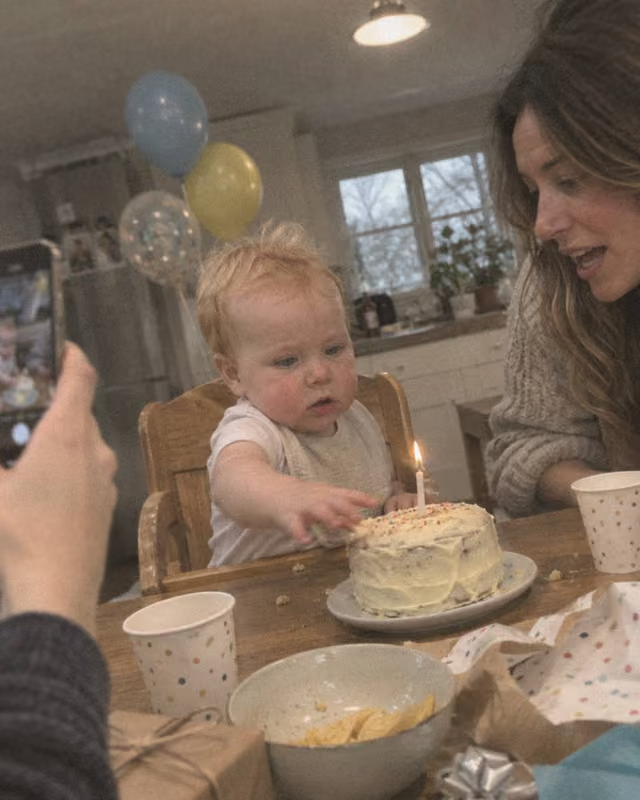
Most family members who post a baby photo do it out of love. They’re proud, they want their friends to see, and nobody told them you’d rather they didn’t. So the ask works best when it comes early, goes to everyone at once, and arrives with something they can say yes to.
Here’s when to bring it up, how to explain it, messages you can copy, and what to do if a photo is already online.
When to bring it up
The easiest time is before the birth, in one message to the whole family, so nobody feels singled out. If you missed that, say it at the first visit, before phones come out. If someone has already posted, ask the same day, privately and kindly. The longer a photo stays up, the harder the conversation gets.
- Before the birth. Expecting parents get asked about names, visits and announcements anyway. Add photos to that list: who announces the birth, whether photos go online, and whether the baby’s name and birth date can be shared.
- At the first visit. At the hospital or at home, a light line works: “Take as many photos as you like, just keep them off social media for us.”
- After a post. Message the person, not the comments. Ask for the photo to come down, and tell them where they’ll see new ones instead.
- When the baby grows. Rules sometimes slip at birthdays and holidays. A short reminder in the family chat before a big day saves an awkward ask afterwards.
How to explain why, without a lecture
One honest reason in your own words is enough. You don’t need to persuade anyone that social media is dangerous, and a long argument can sound like an accusation. Speak for yourselves (“we’d like to”), make the rule the same for everyone, and keep it short. Most family will accept a clear wish from the parents.
Reasons parents often give, in a sentence each:
- It’s their story to share later. You’d like your child to decide one day what of their life is online.
- You want to know who sees them. A post can reach friends of friends you’ve never met.
- Details travel with photos. A hospital wristband, a nursery sign or your street in the background says more than people notice, and a photo taken at home can carry its location. Our guide on removing location from photos shows how to check.
- It’s simpler with one rule. If the rule is the same for everyone, nobody has to wonder whether their post was the one that bothered you.
Leave out what other people do with their own children. The ask is about yours. If you want to read up first, our guide to sharenting sums up what child-safety bodies and parent polls say, without telling anyone to stop sharing.
Give them something instead
A “please don’t” lands better with a “here’s where you’ll see them”. Give family one private place where they see every photo, often sooner than any post would have shown them. A grandparent who can show friends the baby on their own phone has less reason to post. Ask for their photos too.
- Pick one place for photos and send everything there, so nobody feels they’re missing out. Our guide to sharing baby photos without social media compares the options.
- Make it easy for the oldest relatives. If Grandma can’t open it, she’ll keep posting the photos you send her. See sharing photos with grandparents.
- Let them add their own. People who love taking photos want somewhere to put them. A place where they can add to the baby’s story gives them that, such as a guest link that lets friends add photos without an account.
- Agree on what’s fine, if anything. Some parents are happy with a photo where the face can’t be seen, or a post with no photo at all. Say so, and family know where the line is.
Messages you can send
Short and warm works best: one line of thanks, the wish, where they’ll see photos instead. Send it in writing, so people can read it twice and it doesn’t depend on who heard it. Change the words to sound like you, and have each partner send the message to their own side of the family.
To all family, before the birth
We can’t wait for you to meet the baby! One thing we’ve decided: we’re keeping photos of the baby off social media, including the birth announcement. We’ll share every photo with you in a private place instead, so you won’t miss a thing. Thank you for understanding, it means a lot to us.
To a grandparent
We know how much you’ll want to show everyone the baby, and we love that. We’ve decided to keep the baby off Facebook and Instagram, so please don’t post photos. You’ll see every new one first, in a private place we’ll set up on your phone, and you can show your friends from there.
To your mother-in-law, after she posted
Send this from your partner if you can, since it’s their mother.
Hi, the photo of the baby you posted is lovely, and we can see how proud you are. We’d like to keep the baby off social media for now, so could you take it down today? We’re putting all the photos in one private place for family, and we’ll send you the link. You’ll see them before anyone else.
To friends at a party or visit
So glad you’re here! Quick favour: snap away, just please don’t post photos of the baby. If you get a good one, send it to us and we’ll add it to the baby’s album.
A pinned message for the family group chat
A gentle reminder for everyone: please don’t post photos of the baby anywhere online, or send them outside this group. All the photos are in the family album here: [link]. Thank you!
On a party or christening invitation
We’d love you to take photos on the day! We’re keeping the baby off social media, so please don’t post them. Send us your favourites, or add them to the album from the link on the table, and we’ll share them all with you afterwards.
A polite follow-up
Hi, just checking you saw my message about the photo of the baby. Could you take it down when you get a minute? Thank you, we really appreciate it.
If a photo is already up
Start with a private message to the person who posted it; most people take a photo down once they know it matters to you. If that doesn’t work, Facebook and Instagram have privacy forms a parent can use for a young child, and Google can remove photos of under-18s from its search results. Copy the link to the post first.
Facebook. Facebook’s help page on photos that violate your privacy suggests getting in touch with the person who posted first. The quickest way to report is the report link near the photo. There’s also a form called “Report a photo or video that violates the privacy of your child”, for a child under 13. Facebook says you should report only content involving you, your child under 13 or someone you’re the legal guardian or representative of, and that it reviews reports against its Community Standards and can remove content only in specific circumstances.
Instagram and Threads. Instagram’s form, “Report a Violation of your Privacy on Instagram or Threads”, says the right to request removal of a minor’s image lies with the minor’s parent or legal guardian, and that minors aged 13 or older must submit the request themselves. It can’t process a report without a link (URL) to the specific post.
Google Search. If a photo of your child shows up in Google results, Google says it removes images of under-18s at their request, and a parent or relative can start the request. It can make an exception for images that are newsworthy or a matter of public interest. This removes the image from Google Search only, not from the site that hosts it.
None of these forms promise removal, so the private conversation is usually the quickest route.
How TinyThen helps
TinyThen gives family one private place where they see every photo, video and voice note of the baby, so there’s less reason to post. It isn’t open yet. You invite family by email and choose for each person what they see. Friends and guests add their photos from a link or QR code, and they see only what they added, never the rest. Turning off downloads can’t stop screenshots, so the conversation still matters.
Questions
Is it rude to ask family not to post baby photos?
No. Plenty of parents feel the same way. In a poll published in 2015 by the C.S. Mott Children’s Hospital at the University of Michigan, 67% of US parents of children aged 0 to 4 said they were concerned about photos of their child being shared on social media. Asking kindly and early, with somewhere else to see the photos, is how most families handle it.
What if my mother-in-law keeps posting?
Have your partner talk to their mother directly, in a call or in person, and repeat the same clear wish. Thank her for every photo she sends you instead of posting. If posts keep appearing, ask for each one to come down the same day, and think about which photos reach her and through which app.
Should the rule cover photos where you can’t see the baby’s face?
That’s your call. Some parents allow a photo of tiny feet or the back of a head; others prefer no photos at all. Whatever you decide, say it in the first message, so family don’t have to guess.
Can I make Facebook or Instagram remove a photo of my baby?
You can report it. Both have privacy forms a parent can use for a young child, and both review each report before deciding. Neither promises removal, so ask the person who posted first.
How do I ask guests not to post photos at a party?
Say it on the invitation and once more on the day, and give guests somewhere to send their photos instead. A short line works better than a long explanation, and a link or QR code on the table means their photos reach you rather than their profile. Our first birthday time capsule guide shows how to set one up.
What about photos family take themselves?
Their photos of the baby are often the best ones. Ask them to send them to you or to add them to the family’s private place, so they end up in the baby’s story instead of on a public profile.
Sources
- Facebook Help Centre: Photos or videos that violate your privacy
- Instagram Help Center: Report a Violation of your Privacy on Instagram or Threads
- Google Search Help: Remove non-explicit images of minors from Google search results
- C.S. Mott Children’s Hospital National Poll on Children’s Health: Parents on social media, likes and dislikes of sharenting (2015)
 Leo